
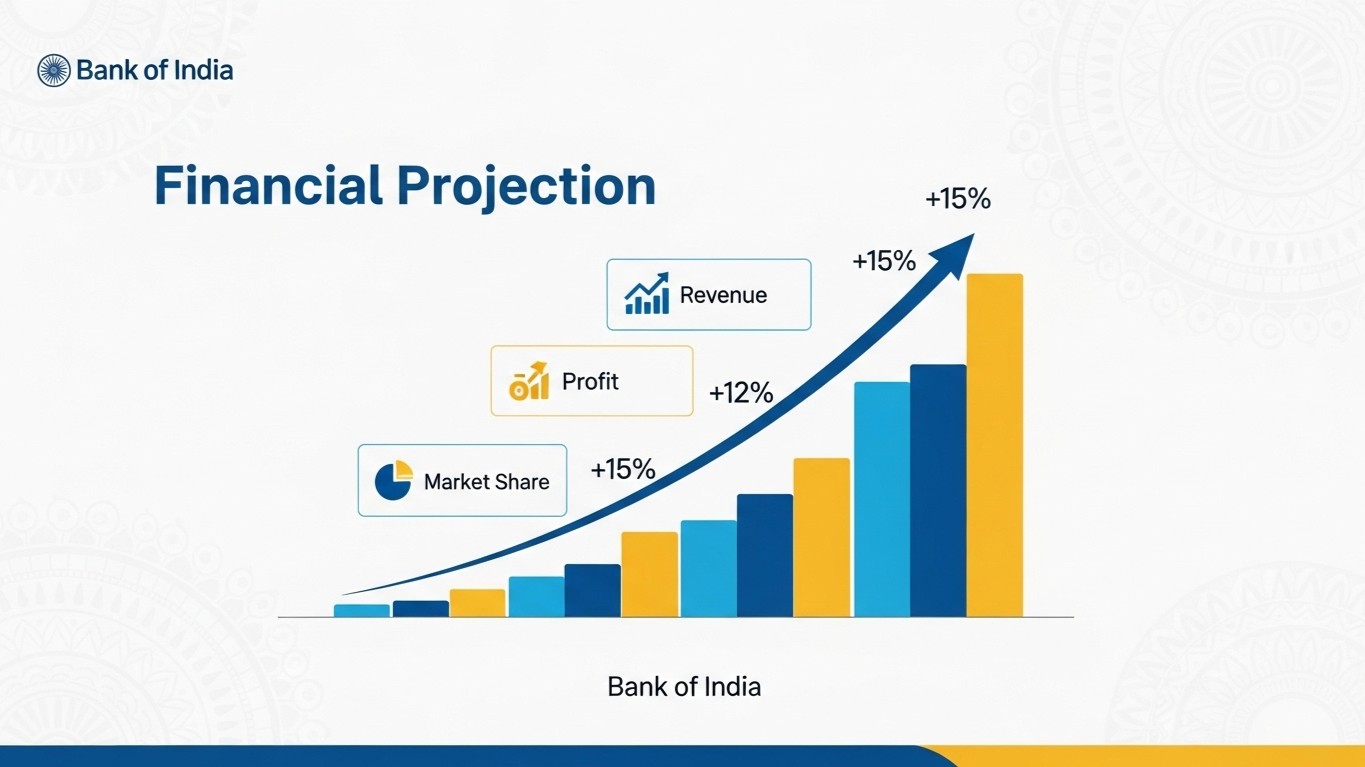

Confirm the requested format before building projections
If you are applying to Bank of India for business finance, first obtain the financial information checklist from the handling branch. The required years, schedules and assessment method can depend on the facility, business and proposal. The structure below is a preparation guide, not an official Bank of India template or evidence that the bank has approved any software output.
Ask whether the proposal needs Credit Monitoring Arrangement data, a Detailed Project Report, or both. CMA data generally explains an existing business's operating performance, financial position and working capital. A DPR explains an investment, its project cost, funding and repayment capacity. The same financial assumptions may feed both, but the purpose and supporting schedules differ.
Set up the heading and year columns
Identify the borrower, constitution, activity, location, reporting unit and requested facility on the cover or summary. Show whether amounts are in rupees, lakh or crore. Label every column audited, provisional, estimated or projected. Record year-end dates rather than using ambiguous labels such as Year 1 without explaining the underlying period.
Use the history and projection horizon requested by the branch. A term-loan analysis should make repayment capacity visible over the relevant borrowing period. Do not assume that a generic three-year or five-year worksheet will meet every proposal. Explain partial first years and any difference between the financial year and the operating period.
Write a factual proposal summary
The summary should state the business activity, existing facilities, additional finance requested, proposed use and promoter contribution. For an expansion, explain what new capacity or operating change the borrowing will fund. Identify the main repayment source and the assumptions that matter most, such as capacity utilisation, gross margin or collection days.
Keep the figures consistent with the detailed schedules. If the summary states project cost of Rs. 120 lakh, the expenditure schedule and means of finance must both total Rs. 120 lakh. Do not describe a working capital limit as money available for acquiring fixed assets unless the lender has expressly structured it for that purpose.
Prepare an assumption schedule with evidence
Each material forecast should be traceable to a source or management judgement. Separate quantity growth from selling-price changes, and show the relationship between output, capacity and utilisation. For traders, use product categories, purchase margins and stock cycles. For service businesses, explain billing capacity, customer acquisition, staffing and collection terms.
- Sales: historical performance, orders, customer discussions and available capacity.
- Direct costs: supplier quotations, yield, freight and production requirements.
- Overheads: staffing plans, lease agreements and recurring commitments.
- Working capital: stock, receivable and creditor holding periods.
- Finance: existing sanctions and proposed interest and repayment assumptions.
Mark uncertain assumptions clearly. An expected subsidy, unsigned contract or proposed capital contribution is not equivalent to an approved receipt. Include its timing and show how the business will fund any delay. This makes the projection more defensible than a spreadsheet that silently assumes all funding arrives before expenditure.
Link the profit and loss statement
Show sales, direct costs, operating expenses, depreciation, interest and tax on a consistent basis. Explain material changes in margins instead of using unexplained percentage improvements. If sales rise sharply, check whether labour, utilities, freight and selling costs should rise too. Distinguish recurring operating earnings from exceptional income.
Illustratively, sales of Rs. 200 lakh and direct costs of Rs. 150 lakh produce gross profit of Rs. 50 lakh, or 25% of sales. If operating costs are Rs. 25 lakh, the surplus before depreciation, interest and tax is Rs. 25 lakh. This illustration establishes arithmetic only; actual figures need business evidence and the correct accounting classification.
Build a balanced projected balance sheet
Carry closing balances forward from the preceding year. Add capital introduced and retained earnings to the relevant equity or capital accounts, then account for drawings or distributions. Reconcile fixed assets to opening cost, additions, disposals and depreciation. Reconcile term debt to opening balances, disbursements and principal repayments.
Derive stock and customer balances from operating assumptions rather than inserting amounts to force the desired limit. Check that liabilities and equity equal assets in every year. A difference should trigger investigation; it should never be concealed in cash, sundry creditors or promoter loans merely to make the statement balance.
Present cash flow and repayment separately
Profit is not the cash available for instalments. Rising receivables and stock absorb cash, while principal repayment does not appear as a profit and loss expense. Show opening cash, operating movements, capital expenditure, loan drawdowns, promoter funds, debt service and closing cash. Investigate any year or month with an unsupported negative cash position.
Attach a schedule for each term loan showing amount, rate, disbursement, moratorium assumptions and repayment dates. Calculate DSCR using the lender's accepted definition and disclose it. A high average coverage ratio can conceal a weak individual year, particularly when a new unit starts operations after the financial year has begun.
Add working capital and ratio schedules where requested
For a working capital proposal, explain the operating cycle and distinguish other current liabilities from bank borrowings. The working capital gap is total current assets less current liabilities excluding bank borrowings. It differs from net working capital, which deducts all current liabilities. Misclassifying cash credit changes the assessment.
If MPBF is requested, Method I is 75% x (Total Current Assets - Other Current Liabilities). Method II is 75% x Total Current Assets - Other Current Liabilities. Other current liabilities exclude bank borrowings. These are assessment frameworks, not a promise of the sanctioned amount; confirm the method and eligible balances with the branch.
Review the submission as one connected file
Compare historical figures with signed accounts and reconcile material differences with tax returns, bank statements and management records. Check units, dates, rounding, totals and loan balances. Run a downside scenario for slower sales or collections. Keep a version record so revised assumptions do not leave contradictory numbers in the summary and annexures.
Finxora's CMA report software prepares linked statements, MPBF and ratios. Its project report software prepares project costs, projected financials and repayment analysis. Compare the samples with the branch checklist and obtain any additional Bank of India schedules directly from the lender before submission.