
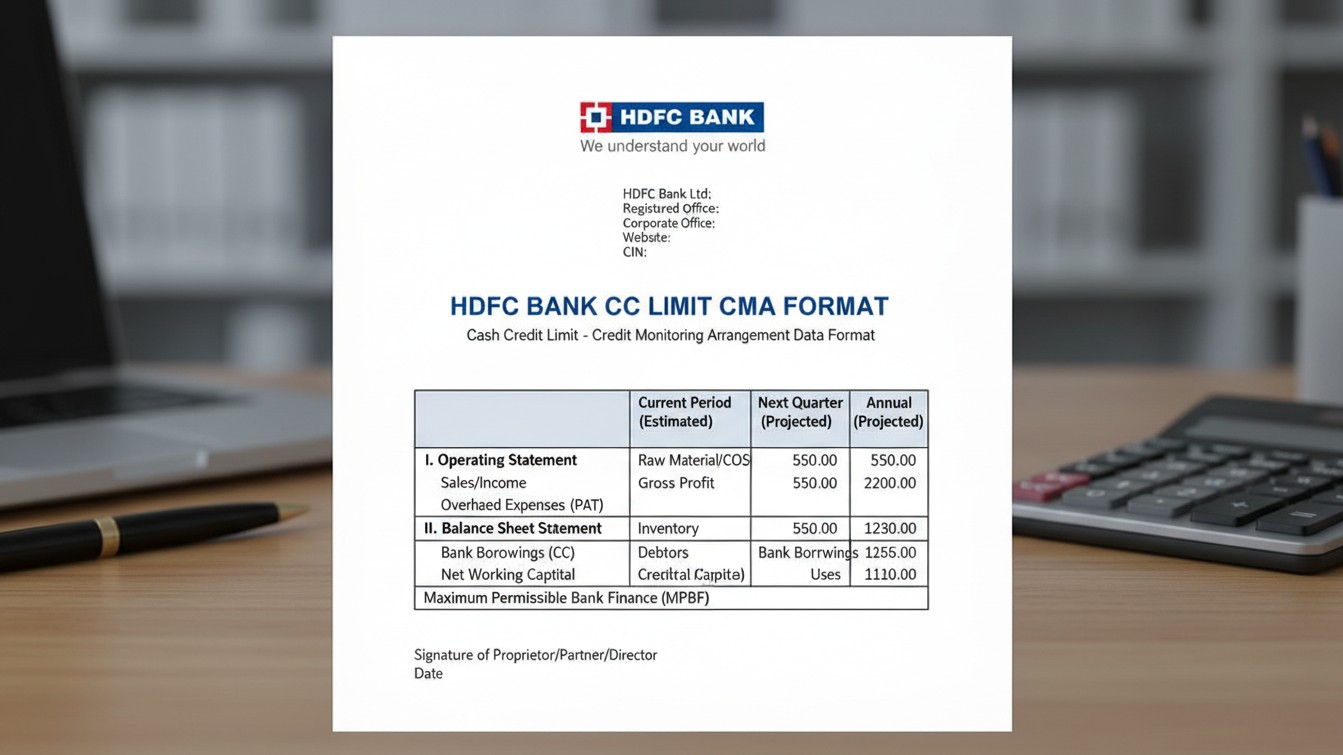

CC here means cash credit
In a business loan file, CC stands for cash credit, not credit card. A cash credit is a running working capital limit that lets a business draw up to a sanctioned amount against the security of stock and book debts, paying interest on what it uses rather than on the whole limit. An overdraft works in much the same way on a current account. HDFC Bank, like other banks, assesses such a limit from the borrower's financials, and the standard pack for that assessment is CMA data.
This guide covers what a cash credit or overdraft limit application carries, what the CMA format contains, how the permissible limit is worked out, and what the credit team looks for. The exact requirements vary by bank and by branch, so confirm the checklist with the relationship manager before you submit.
What CMA data is
CMA stands for Credit Monitoring Arrangement: the format Indian banks use to read a borrower's working capital position. It presents the business as a going concern rather than as a new project, and normally carries three years of audited figures, the current year's provisional numbers and one or two projected years. Every statement in the pack draws on the same inputs, so a change in sales growth flows through the operating statement into the balance sheet, the fund flow statement and the MPBF computation without being retyped.
What the CMA format contains
| Statement | What it shows |
|---|---|
| Operating statement | Sales, direct and indirect costs, interest, tax and net profit for each year |
| Analysis of balance sheet | Capital, reserves, borrowings and the current position, year on year |
| Comparative statement of current assets and liabilities | Movement in stock, debtors, creditors and the working capital gap |
| Computation of MPBF | The maximum permissible bank finance under Method I and Method II |
| Fund flow and cash flow statements | Sources and uses of long-term funds, and how cash moved |
| Ratio analysis | Liquidity, leverage, activity and coverage ratios |
| Turnover method and DSCR | Working capital requirement under the turnover method and debt service comfort |
The pack also carries the borrower's details, the existing credit facilities with other banks, and the projected statements, since the limit is judged against the whole borrowing rather than one account in isolation.
How a cash credit limit is assessed
For larger limits the bank computes the maximum permissible bank finance from the balance sheet. Both methods use the same figures and differ only in how the borrower's margin is measured:
- MPBF Method I = 75% x (Total Current Assets - Other Current Liabilities), where other current liabilities are the current liabilities excluding bank borrowings for working capital, so the borrower funds 25% of the working capital gap.
- MPBF Method II = 75% x Total Current Assets - Other Current Liabilities, where the borrower's margin is 25% of total current assets.
For smaller limits the turnover method recommended by the Nayak Committee is commonly used: the working capital requirement is 25% of projected annual turnover, the borrower brings a margin of 5% of turnover, and bank finance goes up to 20% of turnover. Once a limit is sanctioned, the drawing power on any day is worked from the value of paid stock and eligible book debts, less the margin the bank stipulates and any deduction for unpaid stock or overdue debtors.
Ratios and trends the credit team reads
- Current ratio - current assets against current liabilities, the first test of whether the business can meet short-term dues.
- TOL/TNW - total outside liabilities against tangible net worth, showing how far the business leans on outside funds.
- Holding levels - stock and debtor days against creditor days, which show how long cash stays locked in the cycle.
- Interest coverage and DSCR - whether profit covers interest and debt repayments with a margin left over.
Banks read the trend, not one year. A current ratio that improves as the projections settle, with faster stock and debtor turnover, is a stronger case than a single high figure reached by holding creditors back at the year end.
Documents that go with the assessment
- Balance sheets and profit and loss accounts for the last three years, with audit reports.
- Income tax returns and computations for the same years.
- GST returns, and the sales and purchase registers if asked for.
- Bank statements for existing accounts, and sanction letters for any facility already running.
- Stock and debtor statements as on a recent date, with ageing.
- Entity documents: constitution, PAN, GST registration and Udyam registration.
Keep the CMA figures consistent with the returns, the GST data and the bank statements. A mismatch between the turnover shown in the pack and the turnover in the returns is the quickest way to slow an assessment down.
Preparing for the annual review
A cash credit limit is normally reviewed every twelve months, and the review asks for fresh CMA data with updated provisional figures and revised projections. Because the borrower's master stays saved in the software, a renewal updates the provisional and projected years instead of rebuilding the file, and the comparative statements show the movement the bank wants to see.
Common gaps in a cash credit file
- Projections that grow faster than the market the unit actually sells into.
- A current ratio that is healthy only because creditors were stretched at the year end.
- Stock and debtor days far out of line with what the trade normally experiences.
- CMA figures that do not agree with the returns, the GST data or the bank statements.
- A limit asked for without the MPBF or turnover method working shown behind it.
How Finxora prepares the CMA pack
Finxora's CMA report software takes the borrower's figures once and builds the operating statement, balance sheet analysis, comparative statement of current assets and liabilities, MPBF under both methods, fund flow, cash flow, DSCR, turnover method, sensitivity and break-even analysis, depreciation and EMI schedules, and a ratio set covering liquidity, profitability, leverage, activity, expense and growth across 20+ financial ratios. Figures already prepared in the balance sheet module can seed the historical years, and closing balances carry forward year to year.
Every report exports as a formatted PDF, an Excel workbook or a Word document, with the statements you select included. Open a filled sample CMA report to compare it with the format your bank shared, build the file in Finxora's CMA report software, and see the CMA plans when you are ready to download.