
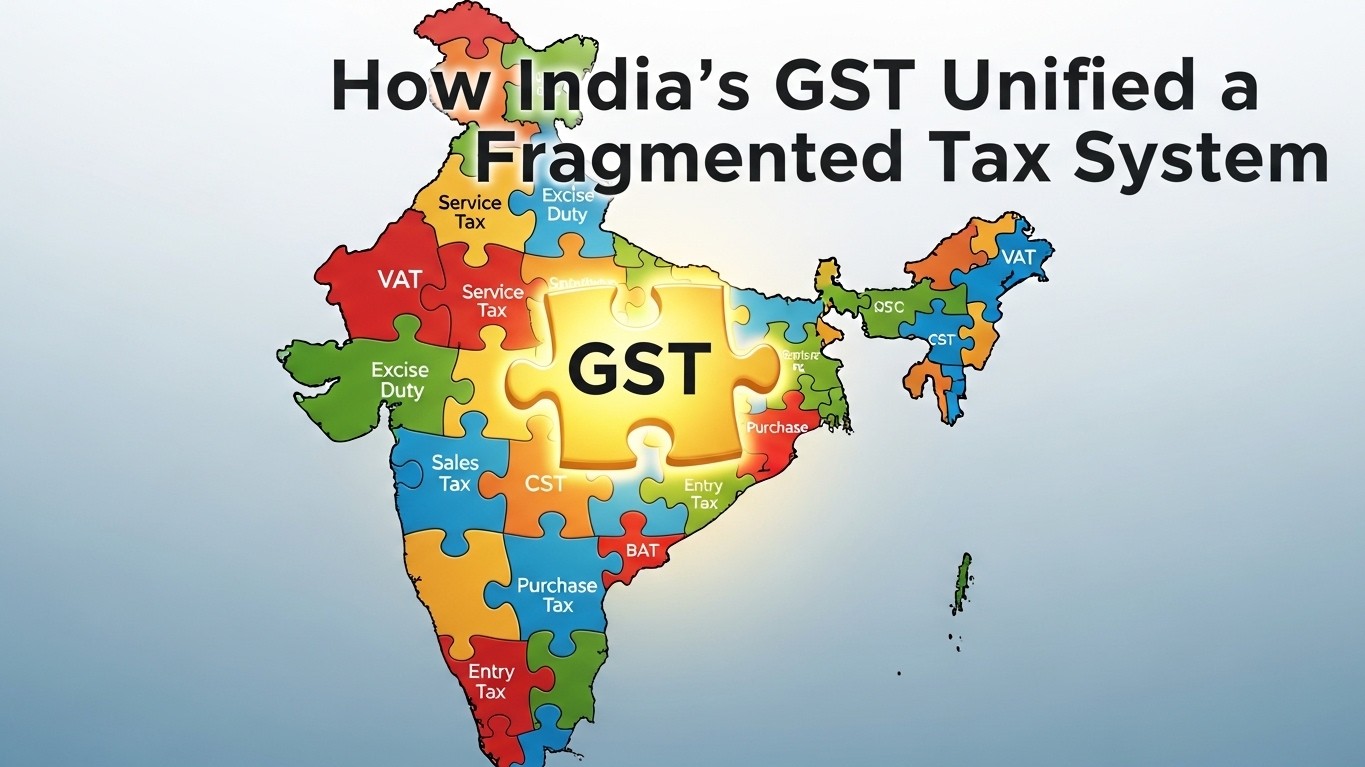

The tax system GST replaced
Before 1 July 2017, an Indian business could pay several indirect taxes on a single product. A manufacturer dealt with central excise, a service provider with service tax, and a trader with state value added tax. Moving goods across a state border added central sales tax, and depending on the state, an entry tax or octroi. Entertainment, luxury and advertisement all carried their own levies. Each tax came with its own return, its own registration and its own officer.
The Goods and Services Tax replaced that set of levies with one tax on the supply of goods and services. The change was carried through the 101st Constitutional Amendment Act, 2016, which gave both the Centre and the states the power to tax a common base and created the GST Council to recommend rates, thresholds and exemptions. The reform is best understood by looking first at what was wrong with the system it replaced.
Cascading tax: the flaw at the centre
Under the old arrangement, tax was charged at each stage of production and distribution, but credit for the tax already paid was limited. A tax paid on an input became part of the cost of the output, and tax was then charged on that higher value. The result was tax on tax, a cascading effect that inflated the final price and made Indian goods less competitive at home and abroad.
The cascading effect also discouraged compliance, because a business could not always use the credit it had paid along the chain. Buyers and sellers had an incentive to stay outside the formal record rather than document every purchase and sale.
Inter-state trade and the patchwork market
Each state was a separate tax jurisdiction. A business selling across India registered in every state where it had a presence, filed different returns and followed different rules. Goods moving between states were stopped at check posts, which added to transport time and cost. Tax was collected at the point of origin rather than where the goods were finally consumed, so producing states gained and consuming states lost. The country had one economy and many tax regimes.
What GST changed
GST is a multi-stage, destination-based tax on value addition. It is collected at each stage of the supply chain, credit is available for the tax paid on inputs at the earlier stage, and the revenue finally belongs to the state where the goods or services are consumed. The tax is levied simultaneously by the Centre and the states on a common base under the Council's recommendations.
Because credit runs through the chain, the tax is paid only on the value added at each stage. That design is what removes the cascade: instead of tax becoming a cost, it becomes a claim against the tax payable on the next sale.
The four components and the Council
GST is one tax with four components, and they decide who collects the revenue.
- CGST is the central share of a supply within one state.
- SGST is the state share of the same intra-state supply.
- IGST applies to an inter-state supply and is collected by the Centre, which later apportions the state's share.
- UTGST stands in for SGST in the union territories that adopted it.
An invoice must therefore state whether a supply is intra-state or inter-state, which is decided by the place of supply rules. The GST Council, with the Union finance minister as chair and a minister from each state, recommends the rate structure and thresholds and settles questions of interpretation, which is how one national tax is kept workable across states.
What a unified market means for a business
- One tax on a supply, in place of a stack of central and state levies.
- Credit for input tax used in the supply chain, so tax already paid is set off rather than absorbed as a cost.
- A common registration and return structure across states, which replaced separate registrations under different laws.
- Electronic movement of goods through the e-way bill, in place of state check posts and entry taxes.
- Consumption-based revenue, so a state benefits when goods are sold inside it rather than only when they are produced there.
What the reform did not settle
Unification removed the barriers, but it did not remove the work. Compliance still falls on the taxpayer, and a small firm with limited accounting staff carries the same filing calendar as a larger one. Input tax credit has to be matched against the supplier's return, and a mismatch can leave credit unclaimed until it is corrected. Classification and rate questions still arise, since the rate depends on the description of the goods or service. Multiple taxes have become one tax but not necessarily one return, and the compensation mechanism designed to protect state revenues was itself a continuing negotiation.
None of this argues against the reform. It explains why GST is best seen as a simplification of the tax base rather than the end of tax administration.
Where small businesses fit
The law recognises that a one-person shop and a national manufacturer should not face the same burden. Registration is required once turnover crosses a notified threshold, which is higher for the special category states, and a small taxpayer below the threshold can supply without registering in many cases. Businesses with turnover under the composition limit can opt for the composition scheme, which replaces the usual rate structure with a flat rate on turnover and a simpler periodic return. Eligible taxpayers can also file quarterly returns with monthly payment of tax, which reduces the number of filings without changing the tax paid.
Keeping the books right under one tax
A single tax makes the accounts easier to reconcile, but only if the books and the returns agree. The invoice-wise tax charged, the credit claimed and the balance in the books should move together, because a loan file or an audit starts from those figures. Statement preparation support sits under the balance sheet software, and the free calculators for interest, EMI and other financial workings are collected under the tools page.
The lasting change
GST did not simply replace one set of taxes with another. It changed the shape of indirect taxation from a collection of state and central levies to one tax on value addition with credit across the chain, and it turned a patchwork of markets into a single one. The cascade is gone, the check posts are gone, and the places where the system still asks for effort are now matters of compliance rather than barriers to trade.