

What GST changed
Goods and Services Tax replaced a set of indirect taxes that were levied separately by the Centre and the states, including excise duty, service tax, VAT, central sales tax and entry taxes. The idea behind the change was a single tax on value addition, collected at each stage of the supply chain, with credit for the tax paid on inputs along the way. Without that credit, tax charged on an earlier sale becomes a cost in the next one, and tax on tax piles up. GST removes that cascade by allowing the payer to set off the tax already paid.
Two features describe how it works. It is a multi-stage tax, because it is collected at each step of production and distribution, and a destination-based tax, because the revenue eventually belongs to the state where the goods or services are consumed rather than where they are produced. It is also a value-added tax: at each stage, tax is paid on the value added at that stage rather than on the full sale value.
The four components of GST
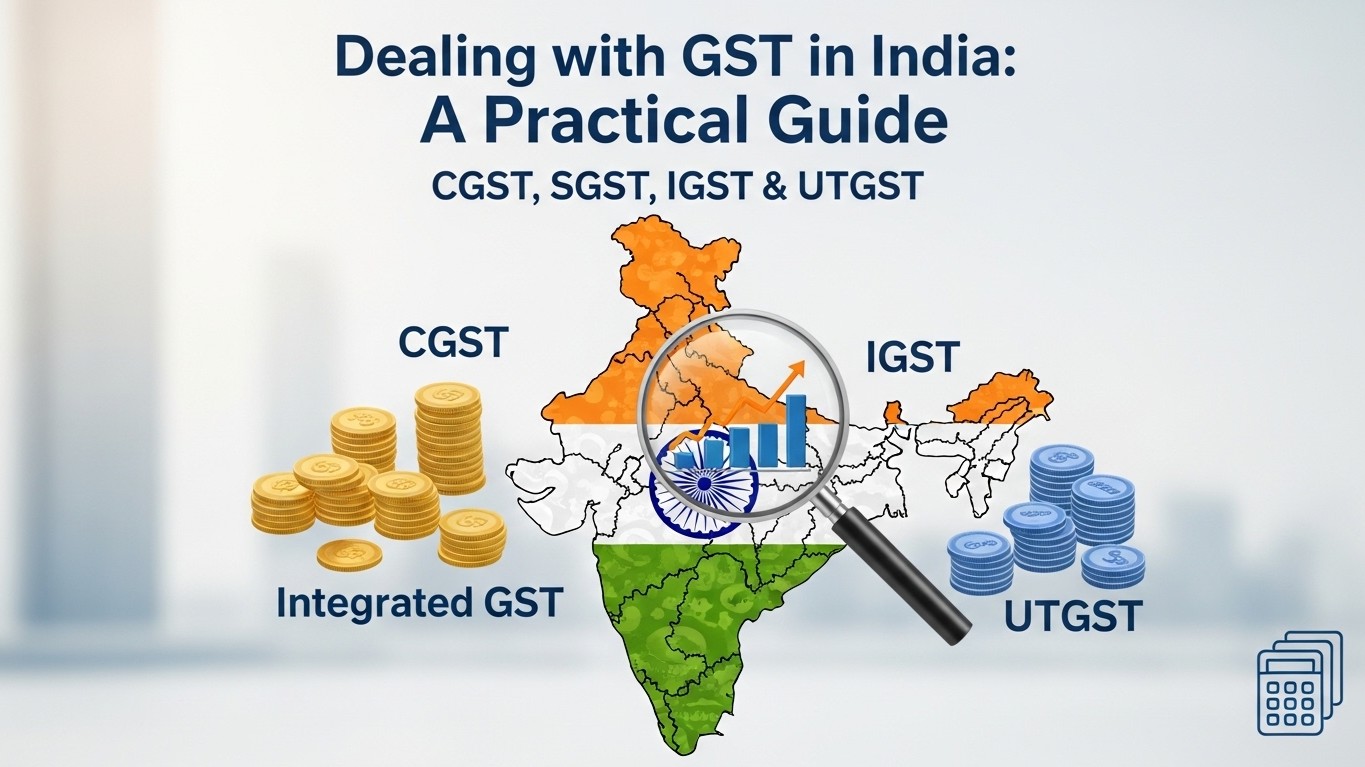
GST is one tax with four components, and they decide who collects the revenue.
CGST: the central share of an intra-state supply
When goods or services move within a single state, the supply is intra-state and the tax is split. The Centre levies Central Goods and Services Tax (CGST) and the state levies State Goods and Services Tax (SGST), each at its own notified rate. If a supply attracts 18 percent GST within a state, it is commonly 9 percent CGST plus 9 percent SGST. The invoice shows both components, and the two credits are used separately: CGST credit is set off against CGST and SGST credit against SGST.
IGST: inter-state supply and imports
When the supply crosses state lines, GST is levied as Integrated Goods and Services Tax (IGST), which the Centre collects. IGST also applies to imports into India. It is charged at the combined rate, so a supply taxed at 18 percent intra-state as 9 plus 9 carries 18 percent IGST inter-state. The Centre later apportions the IGST revenue between the consuming state and the Centre, which is why the credit can be set off against both CGST and SGST.
UTGST: supply inside a Union Territory
Union Territories that do not have their own legislature are covered by Union Territory Goods and Services Tax (UTGST) in place of SGST. Andaman and Nicobar Islands, Chandigarh, Lakshadweep and Ladakh fall in this group, while Delhi, Puducherry and Jammu and Kashmir have legislatures and levy SGST. The principle matches CGST plus SGST: on a supply inside such a territory, the Centre levies CGST and the Union Territory levies UTGST.
How the split works on one invoice
| Supply | Tax charged | Collected by |
|---|---|---|
| Goods or services within the same state | CGST + SGST | Centre and state |
| Goods or services from one state to another | IGST | Centre, then apportioned |
| Supply inside a Union Territory without a legislature | CGST + UTGST | Centre and Union Territory |
| Imports into India | IGST, along with customs duty | Centre |
Why the split matters to a business
The component charged is not a matter of preference; it follows the place of supply rules read with the nature of the transaction. Show the wrong tax on an invoice and the credit will not match in the counterparty's return, leaving both sides to spend time on corrections. Two points are worth checking before any large invoice is raised.
- Where you are registered. Supplying into a state where you are not registered is not treated as a local sale of your own state. The place of supply rules decide the tax, and they may also require registration in the other state.
- How the credit flows. IGST credit can be used first against IGST and then against CGST and SGST, while CGST credit cannot be used against SGST and SGST credit cannot be used against CGST. A wrongly classified supply can therefore leave the buyer with credit that does not settle the tax due.
Input tax credit in one paragraph
Input tax credit is what makes GST a tax on value addition. A registered business pays tax on its purchases and claims it against the tax on its sales. To claim the credit, the invoice should come from a registered supplier, the supply should be for business purposes, and the details should appear in the supplier's return so that they flow into the buyer's electronic credit ledger. A missing invoice, a supplier who has not filed, or a supply used for a non-business purpose can result in credit that is not available, which is why vendor follow-up is part of the monthly routine.
Registration and returns, in general terms
Registration is generally required once turnover crosses the threshold notified for the state and the type of supply, and it is compulsory for certain categories regardless of turnover, such as inter-state suppliers and e-commerce operators dealing in specified supplies. Registered businesses file returns that report outward supplies, claim credit on inward supplies and pay the net tax, with monthly and quarterly schemes available to different categories of taxpayer.
Rates, thresholds and due dates are set by the Act and by notifications that change from time to time. Confirm the current position on the GST portal or with your tax adviser before a filing. Nothing in this article is advice for a particular transaction.
Keeping GST figures with your financial statements
GST payable, input credit receivable and refunds due are balance sheet items, and they affect the current ratio and the working capital position a bank sees. If the books are maintained in Tally, a trial balance exported as XML can be imported into the balance sheet software module, where the GST ledgers map to the right heads after review. Where you are preparing CMA data for a working capital limit, the tax provision flows into the operating statement and the statutory dues appear among current liabilities. For day-to-day working the tools page carries calculators for turnover, EMI and similar figures.